

What's your grammar?
the importance of not specialising and its history.

Originally, I wrote this essay in Italian for a magazine, you can read it here.

There’s a precise moment when that familiar guilt slips in, whispers, and settles into your bones. It doesn’t come at night, it doesn’t knock at your door: it’s already inside by the time you notice it’s there. Maybe it arrives on a Saturday afternoon, when the light is just right and you’re doing something you love, can be playing an instrument, drawing, reading about medieval history, learning a language for no useful reason at all; and then you hear it, sharp and familiar, a background noise, a cutting voice.
I’m wasting time.
The voice isn’t yours, you think, and yet it comes from inside your own body.
The problem isn’t the voice itself, it’s that we rarely ask where it comes from. We take it for granted that someone who chases many interests is a little unfocused, a little undisciplined, unable to choose, full of a thousand ideas they never see through (or simply that they have adhd). That constant consistency is a virtue, and that curiosity, when it spills past the borders of a chosen path, is a form of laziness dressed up as open-mindedness. This conviction has its roots in history, and like all histories, it’s worth starting from the beginning.
Identity or assembly line?
In 1776, Adam Smith writes The Wealth of Nations, offering an example that would become foundational: a pin factory. He divides the production process into eighteen distinct operations; ten workers manage to produce forty-eight thousand pins a day! A single one, doing everything himself, would barely make twenty.
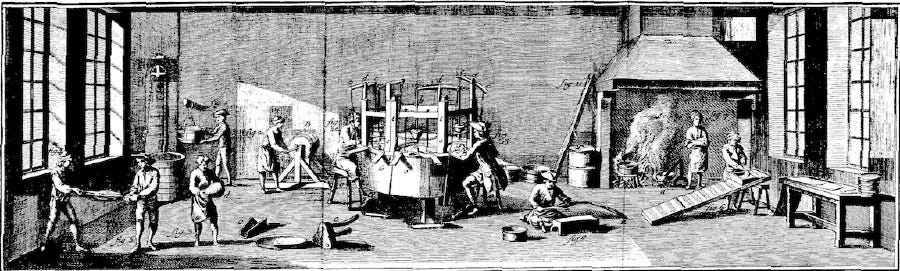
The conclusion is obvious: specialization produces efficiency, and that’s what we want, isn’t it?
What Smith couldn’t foresee, or maybe didn’t want to, is that this principle would leave the factory and enter life in all its departments. We moved quickly from workplace efficiency, which answered the demands of a growing market, to personal efficiency. A century later, Frederick Taylor systematizes scientific management: every movement of the worker is measured, optimized, reduced to the essential. The human body becomes a cog, and the human variable a problem to eliminate or, worse still, to systematize.
Then it’s school’s turn. Ivan Illich writes it in 1971 in Deschooling Society: the modern school institution wasn’t born to shape individuals, but to produce workers functional to a system that needed to know where to find specific skills, in predictable timeframes, at controlled costs, otherwise society would crumble. Children are divided by age, not by interest or aptitude, and they advance in a single block through a curriculum that rewards the right answer and predisposed attitude to “success”, not asking too many questions or the unbridled curiosity (unless it happens to fall in line with the syllabus).
The result, a century and a half later, is a culture in which the résumé is our autobiography, and consistency is the cardinal virtue as well as the most rewarded one. LinkedIn, above all, has simply made the mechanism visible: every experience has to justify itself against the one before, every interest has to be monetizable, or else stay silent, or be celebrated and rewarded. The word dilettante, which in the nineteenth century meant someone who devoted themselves to something for the pure pleasure of it, and was not an insult at all, has become a synonym for superficiality, like saying “being a generalist.” It’s hard to understand why pointing this out should still seem surprising.
The need for permission
Elizabeth Gilbert, in Big Magic, writes something that, in the context of motivational nonfiction, does sound obvious, but is worth underlining here: creativity isn’t a talent you possess, it’s a relationship you cultivate constantly, above all in everyday life. It doesn’t depend on how specialized you are, but on how much you stay listening to yourself, to what asks for your attention, and to that voice that says I want to understand this too.
Obsessive specialization, in this sense, isn’t necessarily a guarantee of excellence. It’s often a strategy for quieting anxiety. You choose an enclosure and you stop hearing the call of what lies outside it. It’s understandable, because the safe compartment gives security, gives identity, gives you something to say when someone asks what do you do. But this enclosure shouldn’t be confused with the security of a promising future, or with staying curious.
Isaiah Berlin, in a 1953 essay devoted to Tolstoy, takes up a distinction from the Greek poet Archilochus: the fox knows many things, the hedgehog knows one big thing. Contemporary culture systematically rewards the hedgehog: whoever has a definitive answer, a defined identity, a clear positioning. The fox is suspect: too much of a generalist, knows many things or perhaps none. And yet Tolstoy, Berlin writes, was a fox who tormented himself for not being a hedgehog and asked himself, constantly, how to become one. And yet, despite being a fox, Tolstoy is universally recognized for his genius.
The counter-misunderstanding
At this point it’s necessary to take a step back, before anyone mistakes the direction of the argument.
To defend a plurality of interests doesn’t mean defending superficiality, constant switching, and a refusal to take on the effort of going deep across the various domains that interest you. Robert Greene, in Mastery, insists forcefully on the importance of the long stretch of time: mastering something takes years, takes sustained attention, takes passing through the phase in which you’re mediocre before becoming capable. All of this is true, and it contradicts nothing of what’s being said here.
The point isn’t how many hours you devote to each thing. The point is understanding what happens when different domains intertwine with one another. Cognitive scientists call it analogical transfer: the ability to carry structures of thought from one field to another, to recognize patterns in apparently distant contexts, to apply to a problem a solution that comes from an entirely different direction.
A musician who studies mathematics doesn’t stop being a musician, on the contrary, they often become a better one, because they’ve learned something about structure, about progression, about symmetry that instrumental practice alone would never have given them. A designer who reads philosophy doesn’t necessarily have to become a philosopher, but might become a designer who asks different questions.
Multidisciplinarity shouldn’t be seen as an escape from commitment. It’s a choice of plural commitment, and a harder one, because it offers neither the alibi of the enclosure nor the security of a “short-term” return.
A grammar is something you carry everywhere
Coming from an Italian background, grammar is often the most daunting domain scholars have to go through, and rarely understand the importance of it. Grammar is not only the essential structure through which we communicate, but a metaphorical guide for life. Just like humans, grammar lives through rules (but mostly through exceptions).
And Gae Aulenti represents exactly the exception that proves the rule. Architect, designer, theatrical set designer, curator of museum installations: her career runs across disciplines that, on paper, seem to have little in common. And yet there’s nothing in her work of someone who does too many things and none of them well. There is, on the contrary, a continuity of vision that runs across materials and contexts: a way of thinking about space, light, the relationship between whoever inhabits a place and the place itself, that is easily recognizable from La Scala to the Musée d’Orsay.

The thread wasn’t the discipline, but a grammar: a set of questions, of aesthetic values, of ways of standing in front of a problem that she carried with her wherever she went. The consistency wasn’t just in the professional label, which she loved so passionately, but in the sensibility of her taste and her gaze.
This is the distinction that the conversation about specialization tends to ignore: there’s a difference between having a disciplinary identity and having an intellectual identity. The first dictates what you do, the second dictates how you think. And it’s the second, in the long run, that determines the quality of the work in whatever field you do it.
What’s your grammar?
There’s a widespread guilt in devoting yourself to something that doesn’t appear in your formal path, that doesn’t translate directly into marketable skills, that doesn’t justify the time you give it. That guilt doesn’t come from within, but from a system that has learned to measure human worth in terms of productivity, of numerical efficiency, of success, and that has internalized this measure so thoroughly as to make it invisible.
Recognizing where the voice comes from doesn’t make it disappear, but it changes the relationship you have with it, and the questions we ask ourselves when, instead, we do something we love.
The question worth carrying with you isn’t “am I wasting time?“, but “what’s my grammar?”. What stays constant, in my interests, in my ways of looking at things, in the questions I ask myself? That continuity is what will eventually shape your whole identity, if you let it.
To become a member, check out the website.
If you want to have a chat, you can find me here:
website | instagram | linkedin
The consumer grammar is difficult to break.
It has stages and theories of thresholds, so much so, education has a direct finish line and says, *I’m all growed up now, and done with it*
The insult upon our species is run by idiots and idols, segregation, whiplash and ‘get er done’ or even ‘just do it’.
The insult upon freedom is an education of ADHD, like a box of matches, they are brought with intent, the consumer intent is always, ‘well if nobody is going to use these matches, I will’.
Replace the word ‘matches’ with any consumer education of materialist parts, give a man a gun and through his own idiocy, will begin the theory of control with intent to do harm, a harm without education, or an education to remove bullets from flesh and the PTSD of friendly fire.
1: it’s even called *bullet points*
The opposite of adhd is a polymath, or *a natural human condition of awareness, not zombie*
A ball of nerve endings, so high in sensory capabilities as to smell a fire two hundred miles away, a nerved wreck of trauma, so invested as to break down in to tears at the colonial exaggerated grammar of expletives, small print, used car salesmen and the protest of Jevon’s paradox as the white flag of peace sitting in the landfill.
A ball of nerves so exposed and raw, any mention of non-linear capability, attracts the evolved mosquito mind to drain all contents and body parts to put it into the bipolarity machine.
For he’s a jolly good fellow, I don’t want to be him rn, the insincerity is crippling.