

being the main character is a matter of leadership
a blog post inspired by one of our workshops!

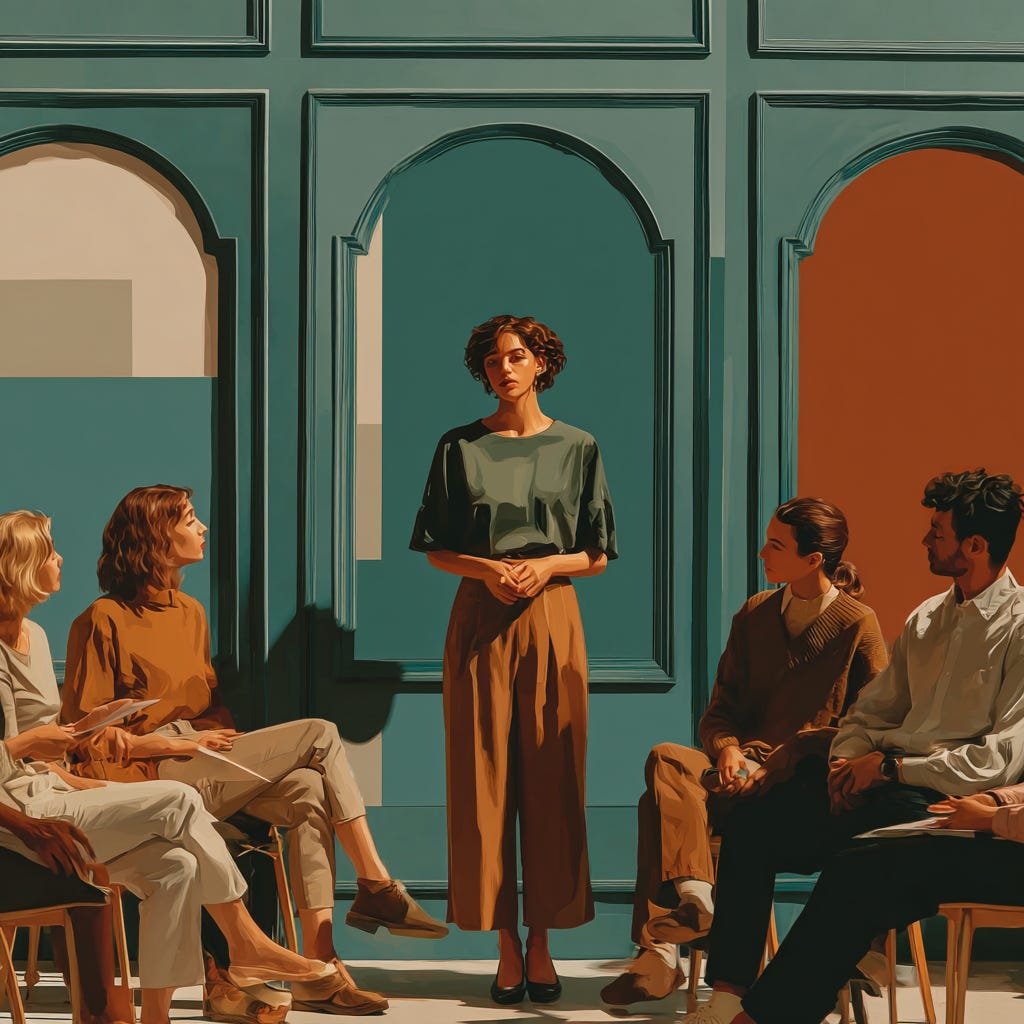
The Modern Renaissance is being built every day by all the generalists out there who never quite feel like they fit in, those of us who love jumping between ideas, who get excited by connections, and who are just trying to figure out how to make it all work (and have a bit of ADHD).
Our first nano cohort is wrapping up soon, and we’re already looking forward to meeting more of you, sharing stories, and building something new together. This is a space for everyone who’s curious, who’s experimenting, and who wants to belong to a community that gets it.
being the main character is a matter of leadership
Leadership can take a variety of presentations, forms. We often imagine leaders as the ones standing in front of the crowd, guiding everyone toward a goal by collecting strength through others’.
However, leading is much more than that. It’s the core concept and truth that stands at the foundation of how you personally lead your life. You’ll eventually find yourself in a leadership position, whether you like it or not.
From leading your life (aka “being the main character”) to leading relationships, friendships, small/large teams. There’s a tendency to only relegate the leader role to someone that is on top, instead it’s that type of person that is able to connect, network, facilitate the conversation, push people to become the better version of themselves, working together towards a common goal.
Leadership should be about mastering the art of living, and for the modern polymath, leadership is generalism in motion.
I. what we used to think leadership was
For centuries, leadership has been drawn with the same line: one figure in front, voice raised, everyone else following. It was a narrative that led to a person in control, not creating.
However, we want to propose a new narrative to fall into when thinking about leadership, which is not hierarchy.
It’s a frequency: a way of moving through life that invites others to move differently too.
We unfortunately inherited an industrial version of leadership: measurable, target-driven, obsessed with performance (damn you productivity gurus). But when thinking about your life, your work is not to perform leadership; it’s to embody direction, especially if you’re a polymath. To live in such a way that people sense coherence in you, and it gives them permission to find their own.
Leadership today is not just guiding a group toward a goal, but making space for vulnerability and authentic connection. This relational approach is the ‘gravity’ that real leaders provide, making them not directors but catalysts of shared direction and growth.
II. new and unforeseen terrain: leading without a map
We live in an age where the paths we’re told to follow seems linear, yet our curiosities are not, they expand, try, cross contaminate each other, they search and look for more.
And to a big part of this world, that looks unfocused. But to the Renaissance spirit, it’s integration in progress, a direction when getting the lead back to your life.
Leading your own life as a generalist means accepting that no one has done this exact combination before, or if they do, they might not have share it, so you’re still pioneering, isn’t that exciting?
You’re not climbing a mountain, you’re drawing a new one.
And because of that, leadership becomes less about leading people and more about leading energy. It’s the daily decision to move from intention, not inertia, that will inspire others to do the same. To make time for depth when the world rewards speed and creating without looking for beauty. To pause long enough to listen to what’s actually alive in you before choosing what to build next, having the courage to build self inquiry.
III. generalism as leadership
Generalism is not distraction (even though it could be seen as so), it’s breadth with responsibility. It’s knowing that every field you enter is a mirror for another: physics teaches you rhythm, music teaches you empathy, design teaches you communication, medicine teaches you precision and care.
A true generalist leads by connection, not by category. They find patterns across disciplines, cultures, and minds; the same way a Renaissance workshop combined art, anatomy, architecture, and astronomy under one roof. To lead your life as a generalist is to accept that mastery today is less about depth in one trench and more about the quality of the bridges you build between them. It’s to replace the corporate ladder with a network of resonances.
While generalists are praised for seeing connections and fostering innovation, it’s important to recognize the depth vs. breadth tradeoff. Deep specialists can drive breakthroughs in established fields, while generalists synthesize and spark new questions. For polymathic leaders, this means balancing breadth with clear accountability, ensuring that the bridges you build are both meaningful and responsibly maintained.
The polymath not only traverses multiple domains but also develops influence through breadth. Lateral influence (shaping decisions and culture without direct authority) demands flexibility, curiosity, and the ability to translate between worlds. This is the true leadership advantage of the Renaissance mind: shaping environments by fostering collaboration and planting ideas across boundaries. To lead as a generalist means also embracing systems thinking to a whole new level. This means seeing the organization as a living network: bridging ideas, people, and purpose.
IV. the Renaissance compass
A polymath life doesn’t necessarily mean that you’re becoming an expert in so many different fields, it’s just a mentality that will help you get your lead back into your life, and making space for all the things that you love or would like to expand. You don’t need to become Leonardo da Vinci, but you do need to look at how he led his life and start integrating what would work for you through continuous experimentations. This is how you lead yourself, and eventually others. Trying, listening, observing how others create/lead, and integrating those characteristics in your life.
And if leadership is self-direction, then each of us needs a compass. Not a business plan, not a “30 days to make you a leader” kinda thing, just a direction.
To sketch your own compass, we invite you to do the following:
North will represent your purpose: Why do I lead myself? Where do I want to take myself?
East will represent your values: What will I never trade, even for success?
South will represent how you changed: What are the things you’re leaving behind or you’d like to leave behind?
West represents your boundaries: Where do I stop to stay whole?
And by looking back to the past weeks/months/years, you can see how you’ve changed, how you’ve gravitated towards the north, with east and west defining your path.
Everything else can rotate around that. True leadership is forged in liminal spaces: the moments between certainty and discovery, past and future selves. Embracing these in-between places gives permission for learning, experimentation, and transformation. The most important compass is not for the terrain you know, but for the journey that asks you to become.
V. closing thought
We don’t need more leaders telling people where to go. We need more humans who live in such alignment that their life becomes direction, creating a gravity others can feel.
That’s what it means to lead your own Renaissance: to cultivate many passions without apology, to build coherence through flexibility and curiosity, to be both student and teacher.
And maybe that’s all leadership ever was: not direct power, but presence. Not control, but coherence.
This substack blog post has been inspired by the workshop host by an incredible polymath and leadership development coach, Dragana Malavika.
Other articles you should read on leadership:
How Authentic Leader Humility Shapes Follower Vulnerability: https://www.sciencedirect.com/science/article/abs/pii/S0749597817308890
Leadership philosophy: https://aeon.co/essays/why-main-character-syndrome-is-philosophically-dangerous
👏👏
Leading self is a constant leadership practice. It is not a one and done thing. You get a chance to be a leader everyday. Even when you become a leader of others and in larger systems, you must continue to lead yourself!